


Self-stimulatory behaviors, also known as stimming, is commonly associated with children who have autism spectrum disorder (ASD). However, stimming is by no means exclusively something that only people with autism do.1
In fact, stimming is quite common among neurotypical individuals, both with children and adults. Stimming may look a little different in individuals with autism and those without, though the reasons behind the behavior may be the same.
For many people, stimming behaviors aren’t harmful and are done to help them deal with different things they may be feeling. For children with autism, though, stimming may be an uncontrollable behavior, to a point, and may even be harmful in nature.
Below, we’ll take a look at what stimming is, discussing the similarities and differences between the behavior in both people with autism and those without.
Can You Stim Without Autism?
Yes, stimming is not limited to people with autism, and stimming behavior does not necessarily indicate autism.9
| Category | Stimming in Individuals With Autism | Stimming in Individuals Without Autism |
|---|---|---|
| Common Purpose | May help a person cope with emotions, sensory input, anxiety, or feeling overwhelmed. | May help manage stress or anxiety, release extra energy, or provide a natural way to self-soothe. |
| Frequency | May occur more frequently, particularly when sensory or environmental challenges are present. | May occur occasionally and can be closely connected to specific emotions or situations. |
| Common Triggers | Sensory overload, loud sounds, bright lights, crowded environments, anxiety, or changes in routine. | Nervousness, stress, excitement, boredom, excess energy, or other emotional situations. |
| Physical Movements | Hand flapping, rocking, spinning, or other repetitive movements. | Leg bouncing, finger tapping, hair twirling, rocking, nail biting, or similar repetitive movements. |
| Verbal Behaviors | Echolalia, humming, or making repetitive sounds. | Whistling, muttering, humming, or repetitive throat clearing. |
| Object-Related Behaviors | Spinning objects or repeatedly interacting with objects in a particular way. | Clicking pens, fidgeting with small objects, or chewing on an object. |
| When It May Be a Concern | The article recommends addressing stimming when it becomes harmful or dangerous to the child or others. | It is generally not concerning by itself unless the behavior is harmful, dangerous, or otherwise causes concern. |
What is Stimming and Why Do People Do It?
Stimming doesn’t refer to a single behavior but rather a range of different behaviors that a person may exhibit to soothe themselves and/or regulate their emotions. Sometimes, the behaviors are physical, while other times they may be verbal.
Different individuals display different stimming behaviors for different reasons.
For people who don’t have autism, some common reasons could be to manage anxiety or stress, to release extra energy, or to interact with the world around them. It’s more so an instinctual response for people without autism that helps them to cope with various situations.
Stimming is similar for children with autism, in that it’s a behavior they do to cope with what they’re feeling. However, it’s often much more frequent because of the challenges they face in processing information and interacting with their environment.
For instance, people with ASD often experience sensory sensitivities, becoming anxious or overwhelmed easily when they hear loud sounds, see bright lights, are in a crowded room or have even slight changes to their normal routine.4
They may stim in response to try to cope with the sensory overload they’re feeling at the time8. In many ways, this behavior may be something that they do without thinking and may be an automatic response that has a specific trigger.
So, while stimming is similar in terms of its purpose, it can look a little different in people with autism than it does in people without autism.
| Category | Stimming in Individuals with Autism | Stimming in Neurotypical Individuals |
|---|---|---|
| Physical Movements | Hand flapping, rocking, spinning | Leg bouncing, hair twirling, tapping fingers |
| Verbal Behaviors | Echolalia (repeating words), humming, making repetitive sounds | Muttering, whistling, repetitive throat clearing |
| Object Manipulation | Spinning objects, flicking fingers near eyes | Clicking pens, fidgeting with small objects6 |
What Are Some Examples of Stimming Without Autism?
Stimming behaviors can be easier to identify in children who are on the autism spectrum, since they can be more noticeable, more pronounced, more frequent and — in some cases — even harmful.
Stimming without autism can be harder to identify, if only because the behaviors can display in a much wider way. They may even look like typical behaviors in most cases, and go completely unnoticed.7
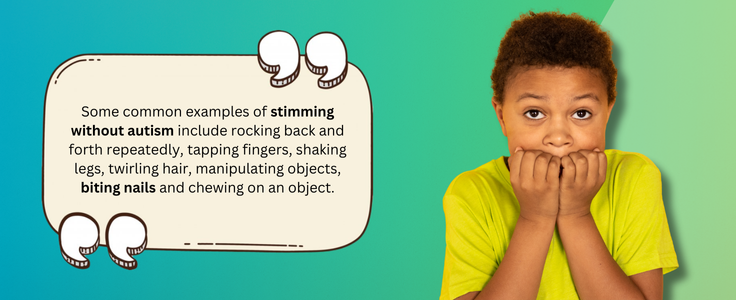
Some common examples of stimming without autism include rocking back and forth repeatedly, tapping fingers, shaking legs, twirling hair, manipulating objects, biting nails and chewing on an object.2
If you’re looking to identify stimming behaviors in your neurotypical child, keep in mind that in most cases, they won’t be harmful or dangerous to your child or to others. They will typically be associated with a specific feeling or situation for that child, meaning that there is usually a specific trigger that causes them to engage in that behavior.
For example, every time your child is feeling nervous, they may tap their legs repeatedly or bite their nails.
Should You Be Concerned if Your Child Stims?
In and of itself, stimming should not be concerning. As mentioned, stimming is a rather common way that children and even adults can help soothe and center themselves when they’re having trouble processing or dealing with certain emotions such as stress and anxiety.3
Of course, if the stimming behavior is harmful to your child or others, then it’s important that you address it — by recognizing what some of the triggers for the behaviors are and helping them modify their responsive behaviors to something more helpful.
Stimming isn’t a direct sign that your child has autism. If you are concerned your child may have ASD, though, you should consult with their pediatrician as well as other specialists who can evaluate them in more depth.
If your child is diagnosed with ASD, they may be referred for applied behavior analysis, or ABA therapy, which is considered the gold standard of treatment options for children on the autism spectrum.
Blue Gems ABA Can Help Children with ASD Regulate Stimming
Both individuals with ASD and neurotypical individuals can display self-stimulatory behaviors, or stimming. By itself, stimming is not necessarily concerning, though it could be if the behavior is harmful or dangerous.
At Blue Gems ABA, we help support children with ASD in many different ways. By administering personalized ABA therapy, we help them build the social, communication and daily life skills with which they typically struggle.
We also help them learn replacement behaviors for any harmful or dangerous behaviors they engage in, including some stimming behaviors.
To learn more, please contact us today.
Learn More About Stimming
- Head Banging and Autism
 Individuals with autism spectrum disorder (ASD) process things differently than others. Their neurodevelopmental disorder affects them in many ways, and it starts with how the brain functions and processes information. While the signs and symptoms of autism can span a wide spectrum, it is commonly characterized by a deficit in communication and social interaction, as… Read more: Head Banging and Autism
 - Stimming Without AutismSelf-stimulatory behaviors, also known as stimming, is commonly associated with children who have autism spectrum disorder (ASD). However, stimming is by no means exclusively something that only people with autism do.1 In fact, stimming is quite common among neurotypical individuals, both with children and adults. Stimming may look a little different in individuals with autism… Read more: Stimming Without Autism
- Excessive Blinking in AutismPart of the Comprehensive Guide to Stimming While autism is a neurodevelopmental disorder that affects people in many different ways, there are some common challenges that people who have autism spectrum disorder (ASD) typically face. This includes difficulty with social interactions and communication in general, as well as restrictive interests and repetitive behaviors. There are… Read more: Excessive Blinking in Autism
- Autism Pinching Behavior: Causes and ManagementPart of the Comprehensive Guide to Stimming When children are young, they engage in many behaviors that aren’t appropriate as they age. This could include putting non-food items in their mouth, banging on furniture and pinching other people or themselves. Some of these behaviors are how children learn the world around them. In time, children… Read more: Autism Pinching Behavior: Causes and Management
- Full Body StimmingPart of the Comprehensive Guide to Stimming Self-stimulatory behaviors, or stimming, is often associated solely with children who have a developmental disorder such as ADHD or autism. However, stimming is actually something that can occur in any individual, regardless of their abilities. People who are nervous, for example, might tap their fingers or shake their… Read more: Full Body Stimming


References
- National Autistic Society – Repeated movements and behaviour (stimming)
- Johns Hopkins Medicine – Motor Stereotypies
- Cleveland Clinic – What Is Stimming?
- National Institute of Mental Health – Autism Spectrum Disorder
- Centers for Disease Control and Prevention – Making an Autism Spectrum Disorder Diagnosis
- MedlinePlus – Autism Spectrum Disorder
- Cleveland Clinic – Stereotypic Movement Disorder: Symptoms & Treatment
- National Autistic Society – Autism and sensory processing
- Healthline – Stimming
