



Tracking developmental care data gives families and healthcare providers a clear picture of the growing needs across local communities.
Autism spectrum disorder (ASD) is a neurodevelopmental condition characterized by unique differences in social communication, behavioral patterns, sensory processing and learning styles1.
Over recent decades, autism prevalence rates have risen across the United States due to broader clinical awareness, improved screening protocols and enhanced diagnostic resources2.
In Arizona, analyzing state-specific data allows parents, educators and pediatric specialists to advocate for accessible care and early intervention services such as Applied Behavior Analysis (ABA therapy).
Below is an overview of the latest autism statistics in Arizona, what these figures reveal about local diagnostic trends and how evidence-based ABA therapy supports children across the Grand Canyon State.
Key Takeaways
- Autism prevalence: Approximately 3.1% of tracked 8-year-old children in Arizona are identified with ASD, highlighting the need for accessible developmental services.
- Early screening matters: Autism indicators may be identified as early as 18 to 24 months, allowing families to pursue developmental support sooner.
- Location affects access: Families in Arizona’s metropolitan areas generally have more specialist and therapy options than those in rural and remote communities.
- Support can span multiple settings: ABA therapy may be provided at home, in clinics or alongside school and daycare environments based on a child’s individualized needs.
What Do the Numbers Show in Arizona?
Data collected through the Centers for Disease Control and Prevention (CDC) and its Autism and Developmental Disabilities Monitoring (ADDM) Network – which tracks local figures via the Arizona Developmental Disabilities Monitoring Program (ADDSP) in Maricopa County – indicates that approximately 3.1%3 of 8-year-old children in Arizona are diagnosed with autism spectrum disorder.
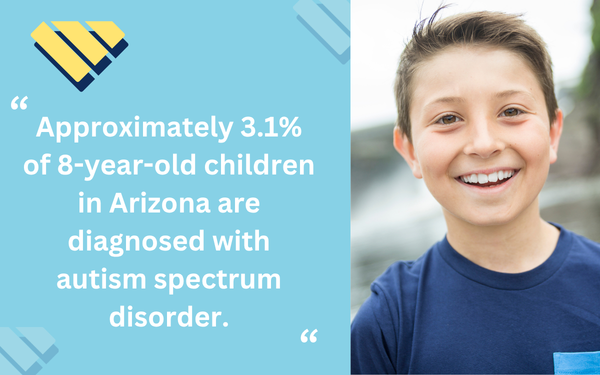
This aligns closely with broader national estimates.
While diagnostic rates continue to rise as access to developmental evaluations expands, distinct factors such as regional healthcare availability and demographic influences shape when children in Arizona receive a formal diagnosis.
Arizona Autism Statistics & Key Trends
| Category | Arizona Insight | Why It Matters |
|---|---|---|
| Autism Prevalence | Approximately 3.1% of 8-year-old children tracked in Arizona are identified with autism spectrum disorder. | The figure highlights the ongoing need for accessible developmental evaluations, educational services and individualized therapy across the state. |
| Early Detection | Developmental evaluations can identify indicators of ASD as early as 18 to 24 months, and more Arizona children are receiving confirmed diagnoses by age 4. | Earlier identification can help families connect with individualized developmental supports during important early learning periods. |
| Geographic Access | Families in Phoenix, Scottsdale, Mesa and Tucson generally have greater access to specialists and therapy clinics than families in rural or remote communities. | Long travel distances, limited provider availability and waitlists can delay evaluations and ongoing treatment outside major population centers. |
| Special Education | Increasing autism identification contributes to growing demand for special education support in Arizona public schools, including IEPs and 504 plans. | School-based services can be complemented by clinical and home-based therapy that helps children practice functional skills across environments. |
| Individualized ABA Support | ABA programs may address functional communication, social interaction, daily living skills and emotional regulation according to each child’s individual needs. | Individualized goals allow therapy to focus on practical skills that can support participation and independence at home, school and in the community. |
Important Patterns in Arizona’s ASD Landscape
Looking beyond the raw percentages reveals key factors impacting how families throughout Arizona navigate early care and ongoing developmental support.
The Critical Role of Early Detection
Developmental evaluations can reliably identify indicators of ASD in children as young as 18 to 24 months5. In Arizona, increased clinical training and screening programs have led to a noticeable rise in diagnoses confirmed by age 44.
However, many children still face delays before securing a formal evaluation. Securing early screening during initial developmental windows allows families to begin targeted interventions when brain plasticity is at its highest.
Geographic Barriers in Rural Communities
Healthcare delivery across Arizona varies significantly between major population centers and rural or tribal areas. Families in metropolitan areas such as Phoenix, Scottsdale, Mesa and Tucson generally have greater access to developmental pediatricians, diagnostic centers and therapy clinics.
Families living in remote desert regions or rural counties often face lengthy travel distances7 and extended waitlists to access specialized care6.
Expanding Needs in Special Education
As the rate of autism identification increases, public school districts across Arizona are seeing rising enrollment in special education programs8. Under the Individuals with Disabilities Education Act (IDEA), Arizona schools offer Individualized Education Programs (IEPs) and 504 plans.
However, clinical and home-based therapy often serves as a crucial partner to school programs, helping children generalize functional skills outside the classroom.
How ABA Therapy Supports Arizona Families
Understanding developmental data is an important first step, but connecting numbers to actionable support is what truly impacts a child’s life.
ABA therapy is widely regarded as the gold standard in autism treatment, utilizing evidence-based strategies to help children build functional independence and confidence.
By evaluating how environment and behavior interact, ABA therapists design positive reinforcement systems tailored to each child’s individual strengths and goals.
Tailored Skill Development
Every child on the autism spectrum presents a unique combination of strengths and goals. Before starting care, a Board Certified Behavior Analyst (BCBA) conducts a thorough baseline assessment to design an individualized therapy plan focused on core developmental domains.
- Functional Communication: Building verbal speech, non-verbal gestures or augmentative and alternative communication tools to express needs10
- Social Connection: Developing joint attention, turn-taking, peer interaction and social awareness
- Daily Living Skills: Supporting independence in self-care routines, toilet training, mealtime habits and personal hygiene
- Emotional Regulation: Teaching proactive coping mechanisms to manage sensory overload, frustration, and daily routine changes.
Flexible Care Environments
So that progress carries over into real-world settings, ABA therapy in Arizona is offered across multiple service environments.
- In-Home ABA Therapy: Focuses on functional routines, family dynamics and daily living skills in the child’s natural environment
- Clinic-Based Care: Provides structured spaces where children can practice social skills and interact with peers under direct supervision
- School & Daycare Support: Collaborates with educators to promote consistency in learning environments throughout the school day
Blue Gems ABA Supports Children with ASD in Arizona
Working through an autism diagnosis can feel daunting, but families in Arizona do not have to walk the path alone. With diagnostic rates highlighting the essential need for accessible, individualized care, Blue Gems ABA is dedicated to helping children on the spectrum thrive.
Our team of clinical professionals works closely with parents to navigate insurance coverage, establish meaningful goals and deliver compassionate, evidence-based therapy9.
To learn more about our ABA therapy services in Arizona or to schedule an initial consultation, please contact us today.
Blue Gems Arizona ABA Centers
Arizona ABA Therapy Resources
Flagstaff AZ ABA Therapy
Mesa AZ ABA Therapy
Frequently Asked Questions About Autism and ABA Therapy in Arizona
References
- National Institute of Mental Health — Autism Spectrum Disorder
- Pediatric Research — Epidemiology of Pervasive Developmental Disorders
- CDC — Community Report on Autism 2025
- CDC MMWR — Prevalence and Early Identification of Autism, ADDM Network, 2022
- American Academy of Pediatrics — Identification, Evaluation, and Management of Children With Autism Spectrum Disorder
- Arizona Health Care Cost Containment System — Arizona ASD Advisory Committee: Access to Diagnosis
- Arizona Board of Regents — Diné Parent Experiences Accessing Autism Services
- Arizona Department of Education — Federal Child Count and Educational Environments Data
- American Psychological Association — Applied Behavior Analysis
- American Speech-Language-Hearing Association — Augmentative and Alternative Communication
